
Researchers suggest new approach to music therapy to help trace change in depression

Researchers at the University of York and the Royal College of Music have proposed a new way of harnessing music therapy for the diagnosis, assessment and monitoring of depression:

“Phatic behaviors in conversation can include small-talk, interjections and gestures which put the other person at ease and strengthen social bonds and understanding. These behaviors can change during depression in a range of ways such as longer pauses within a speaker’s turn, a drop in rate of speech, an overall fall in vocal pitch and a reduction in eye contact.

“The researchers suggest that similar communicative behaviors exist in improvisational music therapy.Continue reading “Researchers suggest new approach to music therapy to help trace change in depression”

Witness to suicide

Witnessing a suicide or finding someone after they have died, whether you know the person or not, can be very traumatic.

The National Alliance for Mental Illness (NAMI) New Hampshire Chapter’s Connect program notes you may have intense feelings and reactions – normal responses to an abnormal event.

NAMI notes:

“People who have lost a loved one to suicide are typically referred to as ‘suicide loss survivors’ or ‘survivors of suicide loss.’ People who have witnessed a suicide death, have come upon the deceased’s body after the fact, or have heard or read graphic details regarding the death are called ‘witness survivors.’”Continue reading “Witness to suicide”

Surviving suicide loss – what to expect

Suicide ripples out through families,  social circles and communities. Whether you have lost a loved one, witnessed or found them after, or witnessed the death of another, the trauma of your loss and experience will affect you in different ways.

According to the American Foundation for Suicide Prevention (AFSP): “Everyone experiences a suicide loss in their own way. There is no list of emotions that will exactly fit your experience. However, many people who have lived through the suicide of a loved one experience some combination of the following feelings and grief responses:

  • Shock
  • Denial and disbelief
  • Grief
  • Rejection and abandonment
  • Anger
  • Guilt
  • Blame and self-recrimination
  • Confusion
  • Relief
  • Betrayal
  • Shame and embarrassment
  • Isolation
  • Depression and sadness
  • Suicidal feelings
  • Yearning for the person

Continue reading “Surviving suicide loss – what to expect”

What research tells us about suicide

The American Foundation for Suicide Prevention is a wellspring of information about suicide and resources for prevention.

Understanding suicide and its root causes are key to prevention efforts.

Here are 10 things learned from research into suicide as compiled by AFSP:

10 THINGS LEARNED FROM RESEARCH

  1. Suicide is related to brain functions that affect decision-making and behavioral control, making it difficult for people to find positive solutions
  2. Limiting a person’s access to methods of killing themselves dramatically decreases suicide rates in communities
  3. Ninety percent of people who die by suicide have an underlying — and potentially treatable — mental health condition
  4. Depression, bipolar disorder, and substance use are strongly linked to suicidal thinking and behavior
  5. Specific treatments used by mental health professionals — such as Cognitive Behavior Therapy-SP and Dialectical Behavior Therapy — have been proven to help people manage their suicidal ideation and behavior
  6. No one takes their life for a single reason. Life stresses combined with known risk factors, such as childhood trauma, substance use — or even chronic physical pain — can contribute to someone taking their life
  7. Asking someone directly if they’re thinking about suicide won’t “put the idea in their head” — most will be relieved someone starts a conversation
  8. Certain medications used to treat depression or stabilize mood have been proven to help people reduce suicidal thoughts and behavior
  9. If someone can get through the intense, and short, moment of active suicidal crisis, chances are they will not die by suicide
  10. Most people who survive a suicide attempt (85 to 95 percent) go on to engage in life

You might be interested in other articles in News and Research.


Public perceptions about suicide and mental health are changing

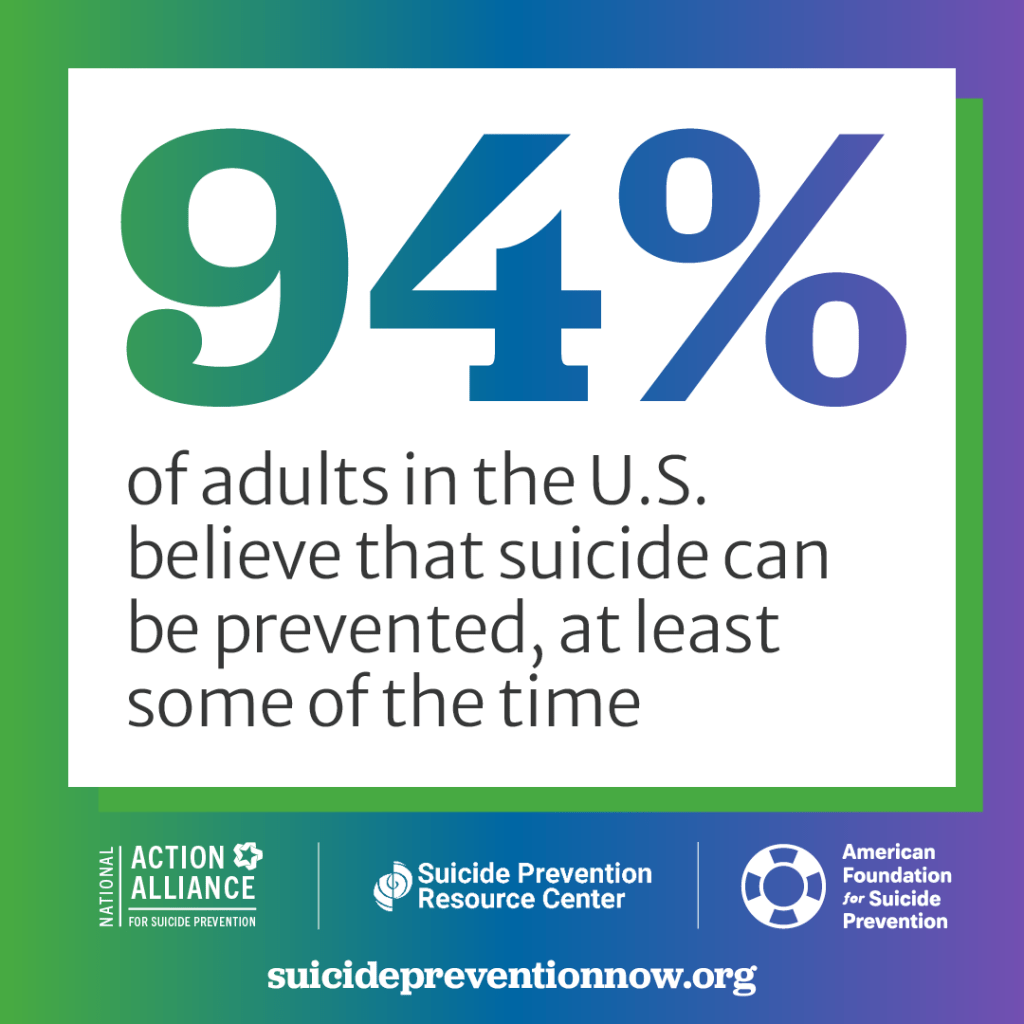
A new national public perception survey reveals the majority of adults in the U.S. (94%) see suicide as a preventable public health issue, and 83% say they would be interested in learning how they might be able to play a role in helping someone who may be suicidal. The American Foundation for Suicide Prevention, the National Action Alliance for Suicide Prevention (Action Alliance) and the Suicide Prevention Resource Center (SPRC) partnered with The Harris Poll to conduct a new national public perception survey of more than 2,000 adults in the U.S. to better understand the public’s attitudes and beliefs about mental health, suicide prevention and the nation’s crisis hotline services. Continue reading “Public perceptions about suicide and mental health are changing”

Can smartphones and Fitbits predict who is suicidal?

A research project in Harvard’s psychology department is attempting to use to use advances in artificial intelligence to do something that has eluded psychiatrists for centuries: predict who is likely to attempt suicide and when that person is likely to attempt it, and then, intervene.

It sounds like the stuff of science fiction, and admittedly has some serious “Minority Report” and Big Brother overtones, but it also has promise for tackling a suicide rate that is the same today as it was 100 years ago.Continue reading “Can smartphones and Fitbits predict who is suicidal?”

Do antidepressants increase the risk of suicide?

Most antidepressants are generally safe. However, the Food and Drug Administration (FDA) requires all antidepressants carry black box warnings about the potential risk of increased suicidal thinking and behavior in some children and young adults under the age of 25.

According to the Mayo Clinic:

“Although antidepressants are more likely to reduce suicide risk in the long run by improving mood, in some cases, children, teenagers and young adults under 25 may have an increase in suicidal thoughts or behavior when taking antidepressants, especially in the first few weeks after starting or when the dose is changed.”

Continue reading “Do antidepressants increase the risk of suicide?”

Suicide, firearms and the case for waiting periods

Half of all suicides in the U.S. are by firearm. Nearly two-thirds of all firearms-arms related deaths in the U.S. are suicides Yet, only four states and the District of Columbia require any kind of waiting period for the purchase a gun.

According to the Centers for Disease Control and Prevention, suicide is the 12th leading cause of death in the U.S. In 2020, 45,979 Americans died by suicide, and an estimated 1.20M attempted suicide.

“No one takes their life for a single reason,” the American Foundation for Suicide Prevention (AFSP) notes. “We all have mental health, just as we all have physical health, and conditions such as depression, anxiety and substance use problems – especially when unaddressed – increase the risk of suicide. That risk is greater when a firearm is present and accessible in the home.

Continue reading “Suicide, firearms and the case for waiting periods”

What suicide loss survivors need most

When you’ve lost someone to suicide, one of the hurdles in recovery is the people who sympathize but don’t know what to say or do. Worse are those who don’t say anything for fear that mentioning your loved one’s name will hurt you. (Pro tip: Not saying their name hurts more.)

To find out what suicide loss survivors needed after their loved one died (and what they still need in the days, weeks, months and years to follow), the American Foundation of Suicide Prevention asked its community to share one way to support someone who’s lost a loved one to suicide.

Continue reading “What suicide loss survivors need most”

If you think someone is thinking about suicide

If someone you know is in crisis, being there and truly listening to them is a huge step toward helping them. Here are concrete steps you can take to make sure they get the help they need.

The American Foundation for Suicide Prevention offers the following advice:

If you think someone is thinking about suicide, assume you are the only one who will reach out. Here’s how to talk to someone who may be struggling with their mental health.Continue reading “If you think someone is thinking about suicide”